BD Engine
A conversion problem that turned out to be a positioning decision the company had never made.
View website (opens in a new tab)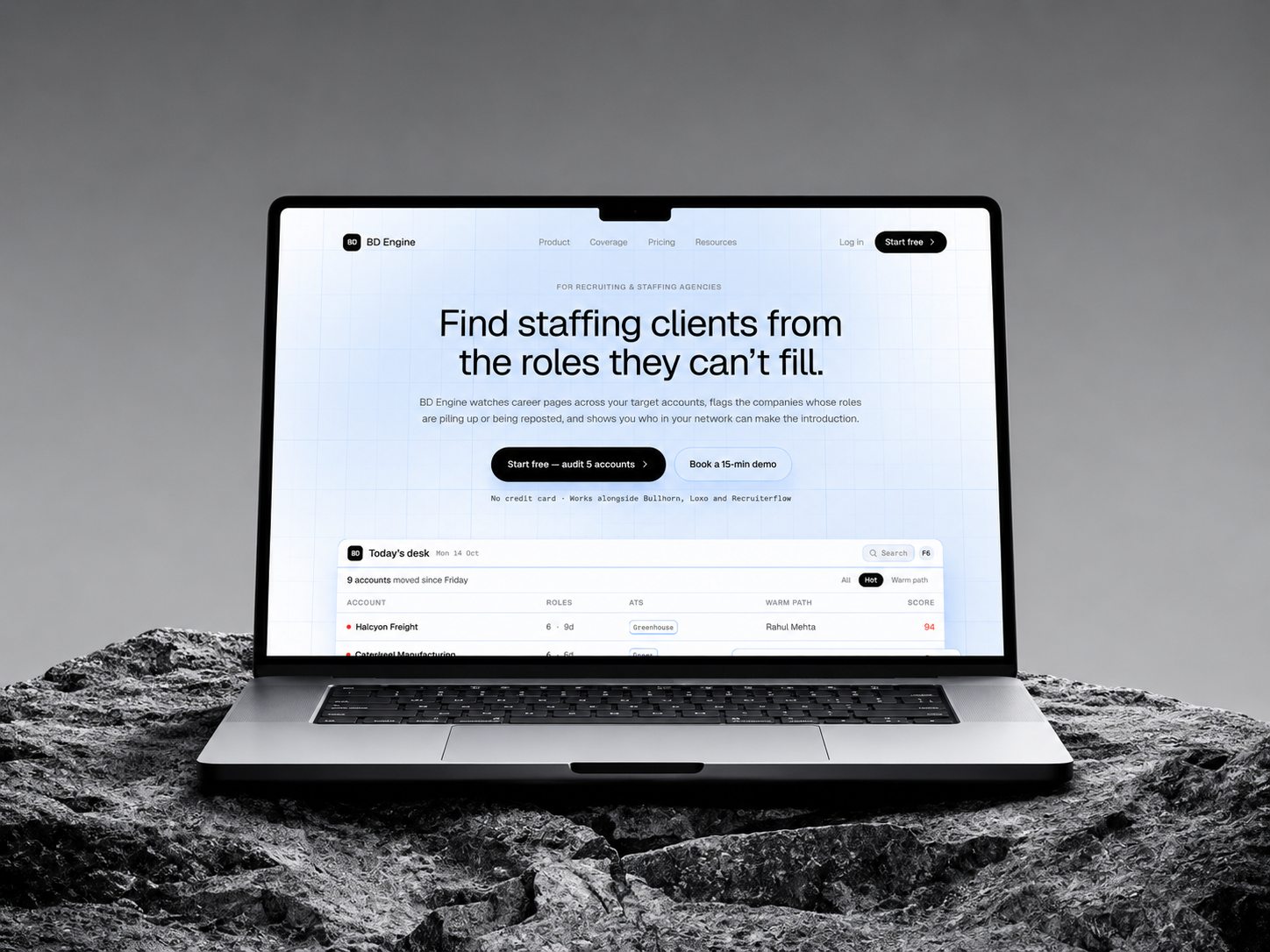
The brief, and the real problem
BD Engine is a business development tool for recruiting and staffing agencies. It watches company career pages for hiring activity, ranks accounts by opportunity, maps the user's own network against those accounts, and drafts the outreach. The product was strong. The website was not converting, and the work began as a mandate to find out why and rebuild it.
The website was not the problem. It was running two mirrored marketing pages for two incompatible audiences, staffing agencies and job seekers, off one codebase with a vocabulary toggle. It led with a category label instead of a value claim, carried no evidence of any kind, and was priced in a way that quietly undermined the product it was selling.
None of that was a design defect. It was a business decision that had never been made, surfacing as a design problem.
The company had not decided who the product was for, and the website was where that indecision became visible and expensive. Before anything could be redesigned, the real work was to make the decision.
The constraints, and why they raised the bar
There was no analytics access, no customer interviews, and a pre-revenue product with no logos or testimonials to lean on. That did not lower the standard, it raised it. Every finding had to be defensible from the page and the market alone, without recourse to "the data shows."
And the constraint that hurt most, no social proof, turned out to be the productive one: it forced provenance and evidence to become primary design surfaces, which for this specific buyer convert harder than testimonials would have.
The decision: commit to one audience
The entire marketing surface was committed to staffing business development, and the job-seeker audience was cut from it. This was not a preference; it was where the evidence pointed, and the decisive piece came from inside the product itself: the app had only ever been built for BD users. The interface, the workflows, the density, the terminology, all of it assumed an agency consultant working a desk. The job-seeker "mode" was not a second product. It was the BD product with the words swapped. The company's own engineering had already chosen an audience, and the marketing was arguing against it.
Everything else agreed. A job seeker who succeeds leaves, so their entire customer lifetime ends the moment the product works; an agency's BD function never stops, because finding clients is a permanent operating requirement. A single placement earns an agency 15 to 25 percent of first-year salary, so the product only has to influence one client relationship a year to be worth buying, a return no consumer job-search tool can match. And the consumer side of this exact idea was already crowded, while the agency side sat open.
One audience was a phase of someone's life. The other was a business that never turns off.
The conditions under which this call would be wrong were logged too, so it stayed testable rather than dogmatic: if the network layer proved weak, or if agencies expected their ATS vendor to bundle the feature, no positioning would fix it.
The rebuild: the page became the argument for the decision
With the audience settled, the commercial surface was rebuilt. The highest-leverage moves:
01The headline was made to do its job.
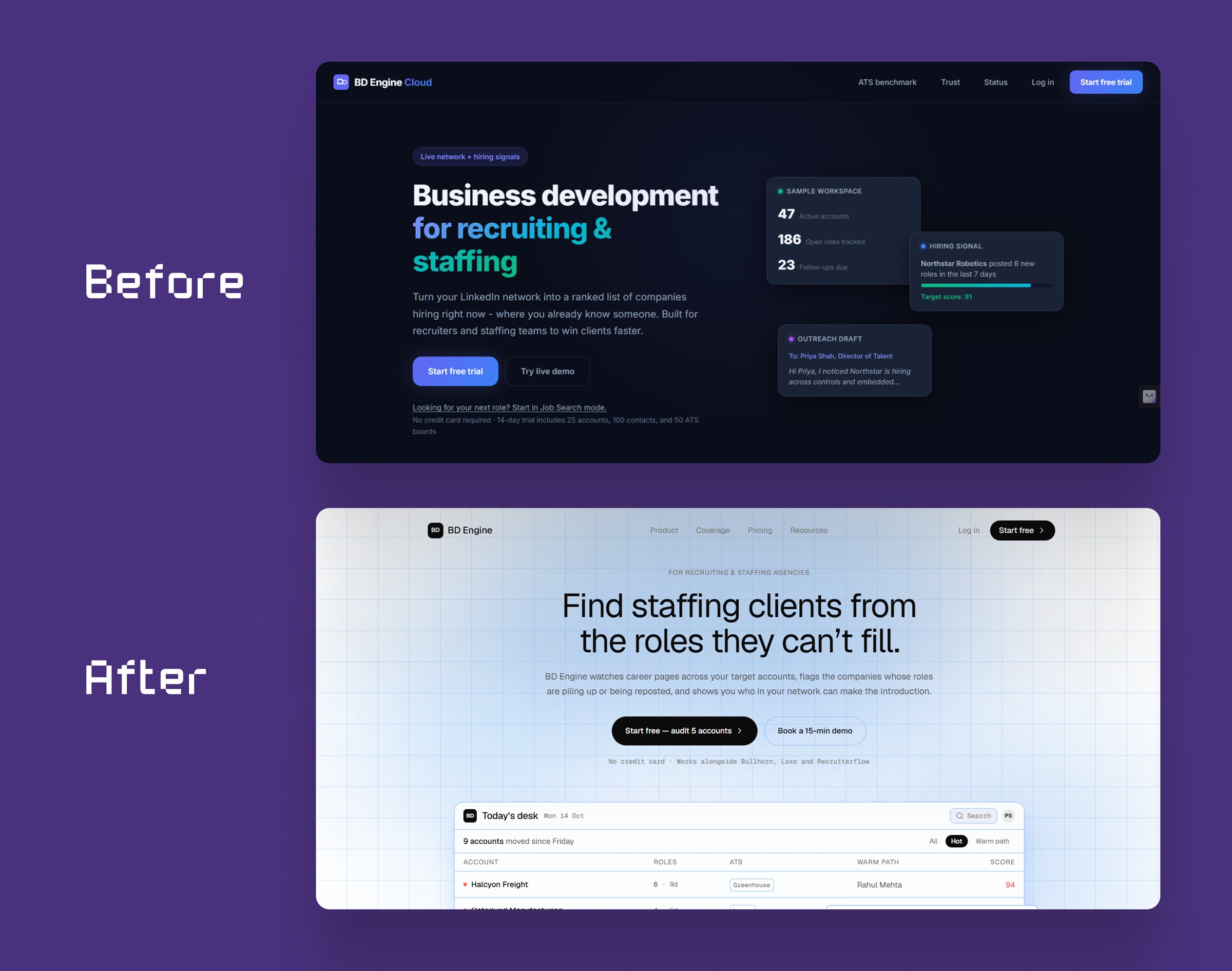
The original H1 was a category label, "Business development for recruiting and staffing," a sentence a dozen competitors could use unchanged. The one sentence on the page a competitor could not copy was sitting one typographic step down in grey body text, at roughly 40 percent of the weight above it. The hierarchy was inverted: the mechanism became the headline, the category became supporting context. The final line, "Find staffing clients from the roles they can't fill," carries audience, outcome, and mechanism in nine words.
02The signal was sharpened by one degree.
The site sold "companies that are hiring." The commercially sharper claim is companies that are stuck hiring. A reposted role is a public admission that a company has failed to fill a position, which is the easiest conversation in staffing, because the prospect already knows they have the problem and the evidence is public. That distinction became the organizing idea of the detection story.
03The page was sequenced against the buyer's real objections.
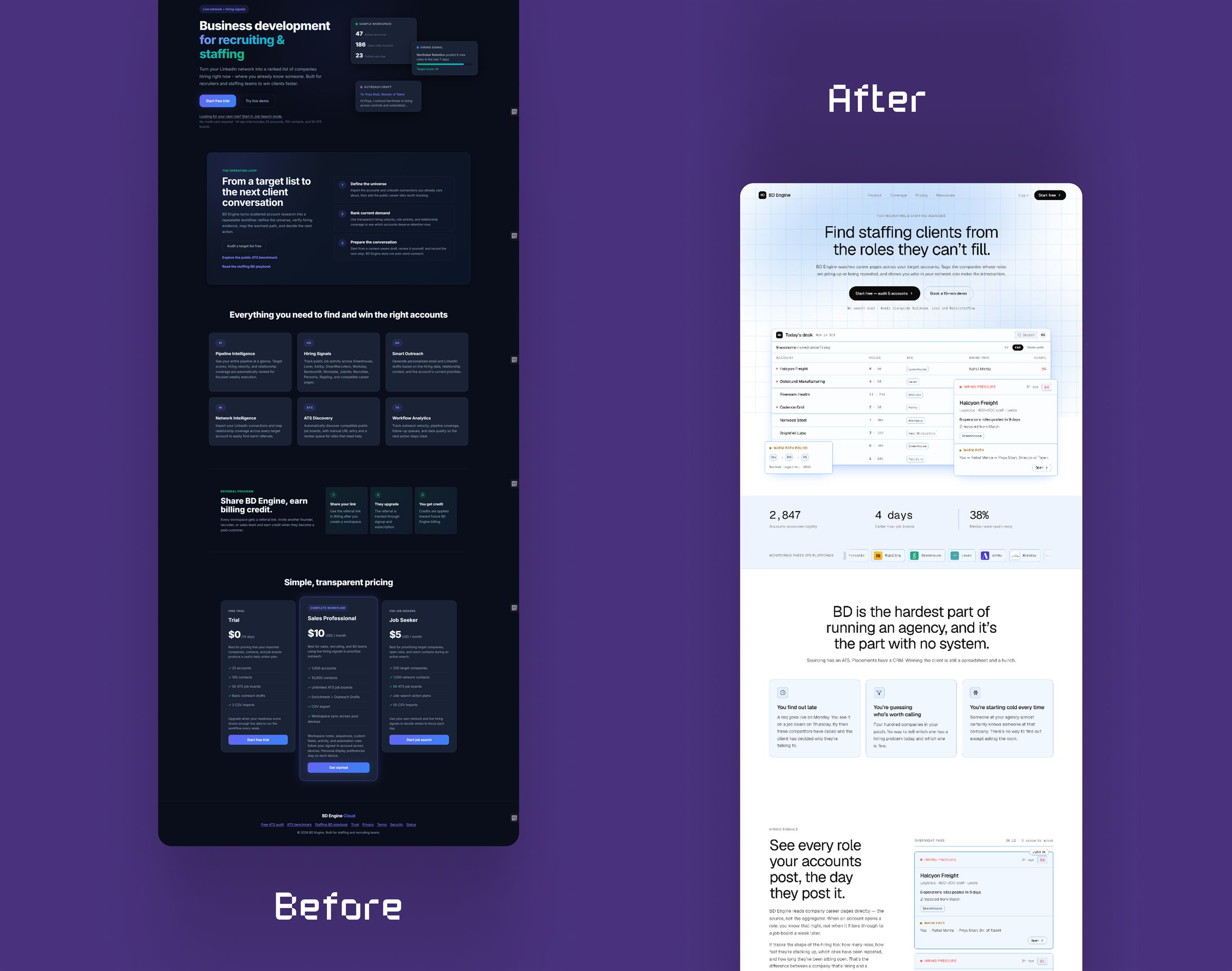
The original jumped from a category label straight into a feature grid, which assumes a visitor who has already decided to buy. The page was rebuilt as an ordered objection queue, running from "what is this and is it for me" through credibility, problem recognition, coverage, adoption effort, proof, the cheaper alternative, data safety, and price, to the final call to action. A visitor can stop at any point and still leave with a coherent picture.
04It was repriced, and this was the largest lever in the project.
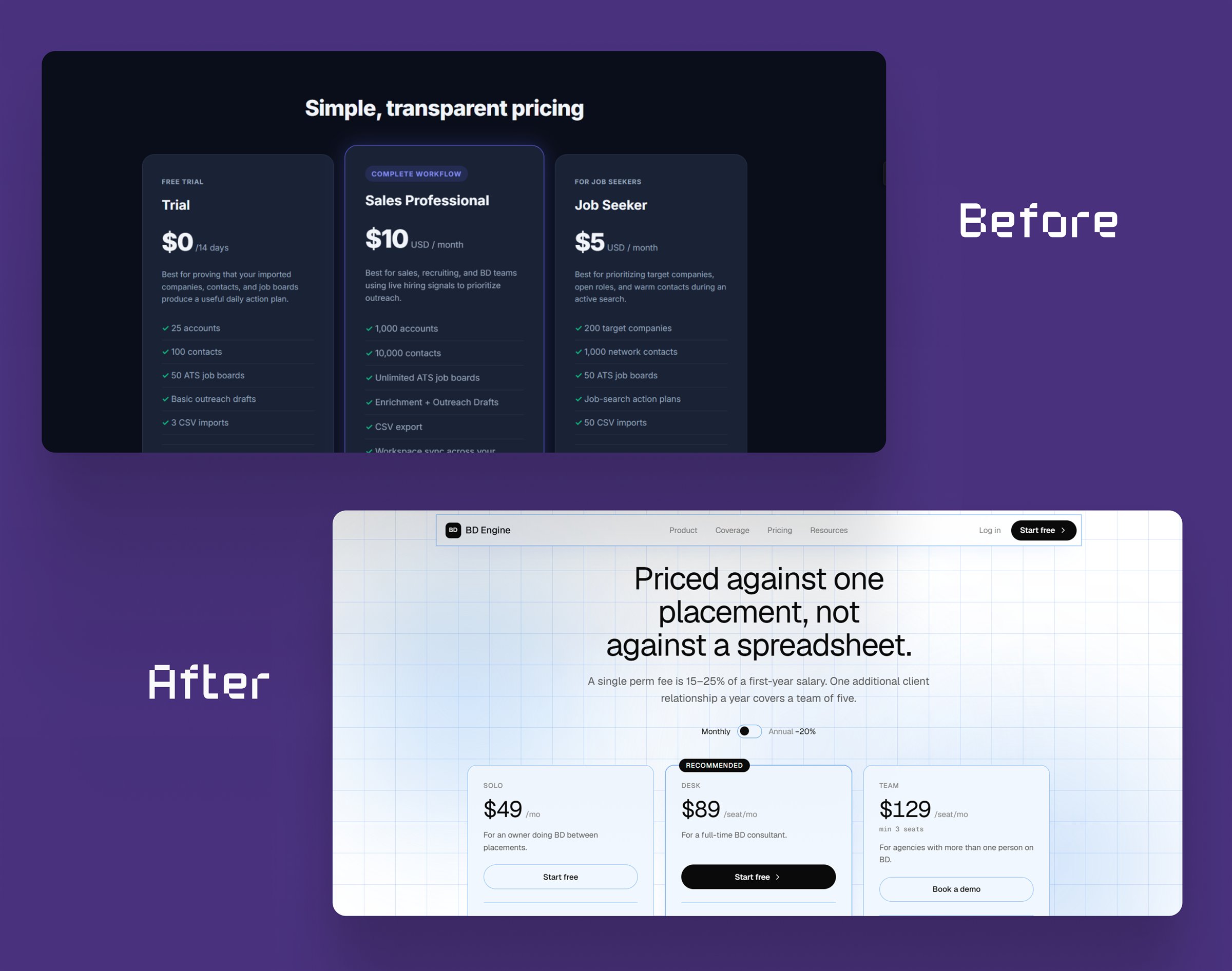
The staffing tier was $10 a month, roughly a tenth of a comparable sales tool, sold to a buyer whose single successful outcome is worth a five-figure fee. In B2B, price is a credibility signal, and $10 does not read as a bargain, it reads as an unserious side project, undercutting every production-quality claim made elsewhere on the page.
It was moved to a $49 / $89 / $129 per-seat structure, with the $89 primary tier anchored to the placement fee the original site never once referenced. On that tier it is an 8.9x increase in target ACV, delivered entirely through positioning, with no feature work.
05Trust was engineered structurally, because there was none to borrow.
With no testimonials available, provenance became a primary surface: a proof bar of operational metrics, a dedicated section naming every data source, explicit statements of what the product does not do, and source-and-age stamps built into the product UI shown on the page. For a data product whose output the buyer will read aloud to a prospect on a call, where stale data ends the relationship and the blame lands on the tool, this converts harder than social proof would.
06The demo became the conversion mechanic.
The primary call to action became a coverage check: paste five target accounts, and before signing up, see which ATS each uses and how many roles are open. It functions as demonstration, proof, lead magnet, and onboarding at once. It answers the first real objection using the visitor's own accounts, which no generic demo can match, and it solves the cold-start problem inherent to this kind of product, where the tool is least impressive on day one before any setup.
07The interface was treated as the art.
The original hero was three floating boxes labelled "sample workspace," which told the visitor outright that what they were seeing was not real, on a product whose entire premise is that the interface does the prioritizing for you. It was replaced with a real, dense, deliberately imperfect product composite, and a light, instrument-like visual system set against the category's dark-SaaS default, closer to a trading terminal than a startup landing page, because that matches the software this buyer already lives in.
Impact, stated honestly
The largest outcome is structural, and it can be stated plainly: the repricing is an 8.9x increase in target ACV on the primary tier, and because the single-audience decision also removes the cost of maintaining a second set of labels, empty states, onboarding paths, and copy, its effect compounds every quarter rather than landing once.
8.9x
target ACV on the primary tier
$10 → $89
the primary tier, per seat
Beyond that, precision matters, because this is a case study about data credibility and it would refute itself to invent a number. No baseline analytics were available, and the redesign is a concept rather than a shipped-and-measured result. So every conversion claim here is a hypothesis with a defined way to measure it, not a result being reported.
What stands on its own is the reasoning: each change is tied to a specific commercial mechanism, a comprehension leak closed in the first eight seconds, an objection answered before the exit point it was causing, a credibility signal corrected. The diagnosis holds from the page and the market without needing a percentage attached to it.
The work in one line
A website that was not converting turned out to be a company that had never decided who it was for. That decision was made on the evidence, and the entire commercial surface, positioning, message, structure, price, and interface, was rebuilt to execute it.
The single biggest lever was not just visual. It was a repricing that positioning made defensible.