Kynectia
A venue-dependent networking app, rebuilt into a city-wide intent network.
The vision
Professionals are surrounded by people who could change their work: collaborators, clients, testers, hires, and can't see any of them. LinkedIn had turned networking into performance, and no one wanted another feed.
The goal was to make the useful people around you actually reachable, in person. That conviction never changed. How to deliver it changed completely, and that is the story of this project.
Enblit: the first bet
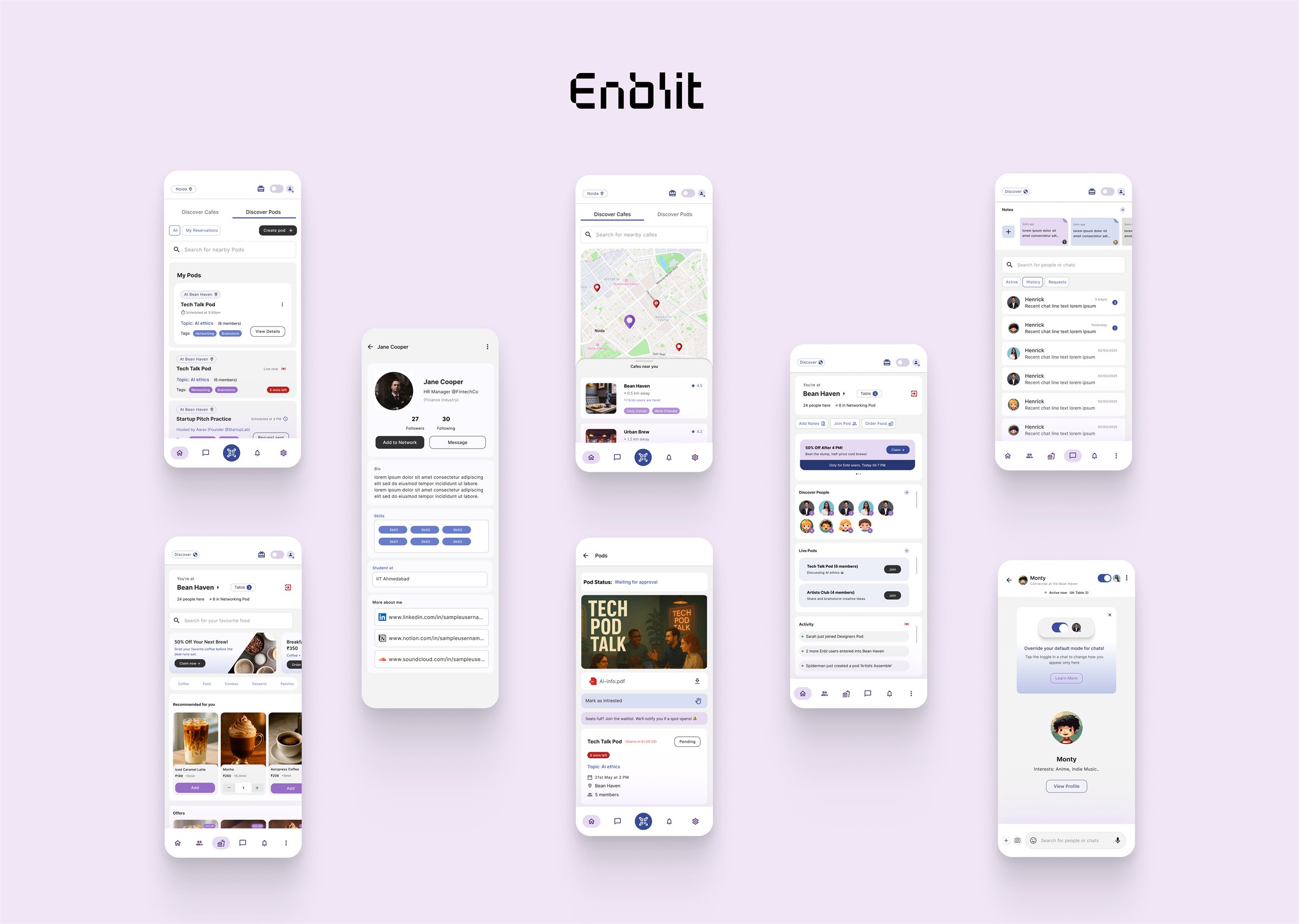
Kynectia began as Enblit, an in-real-life discovery platform anchored in cafés. A user would walk into a partner café, scan a QR code, and unlock a live layer of the professionals around them, then send a request, chat, and meet at the next table. Around that sat pods for small group meets, in-venue menu browsing and ordering, café offers, and a full partner platform for venues to manage menus, tables, orders, offers, and analytics.
It was a complete product. In hindsight, it was too complete for what the business still had to prove.
What the market showed
A web MVP of the discovery feature ran with 50 to 100 users, alongside direct interviews with professionals. Two findings pulled in opposite directions.
The demand was real.
People described using dating apps like Hinge not for dating but to find collaborators, because no proper tool existed for it. Others said LinkedIn felt performative, and that they had no way to meet the right people in person. The problem was genuine.
The architecture was not.
Enblit only delivered value when a stack of conditions held at once: enough cafés onboarded, enough of the right people physically present, matching intent, in the same room, at the same moment, for a behavior that did not yet exist in the market. Discovery needed density that was not there. Pods needed people, and people needed pods. Every meeting depended on a venue being set up first. The entire business had been built around cafés before a single user had shown up for the core promise.
It looked like six problems. It was one: nothing worked until everything worked.
The pivot
The decision was to cut, hard. Looking at the market, the model, and the distribution reality together, the venue-heavy architecture was strangling an idea people genuinely wanted. Enblit was stripped down to the one thing that had resonated in every interview, the intent to meet the right person, and rebuilt around it as Kynectia.
The principle behind the rebuild
One person should be able to create value alone. No café, no crowd, no critical mass required first.
Kynectia: intent as the product
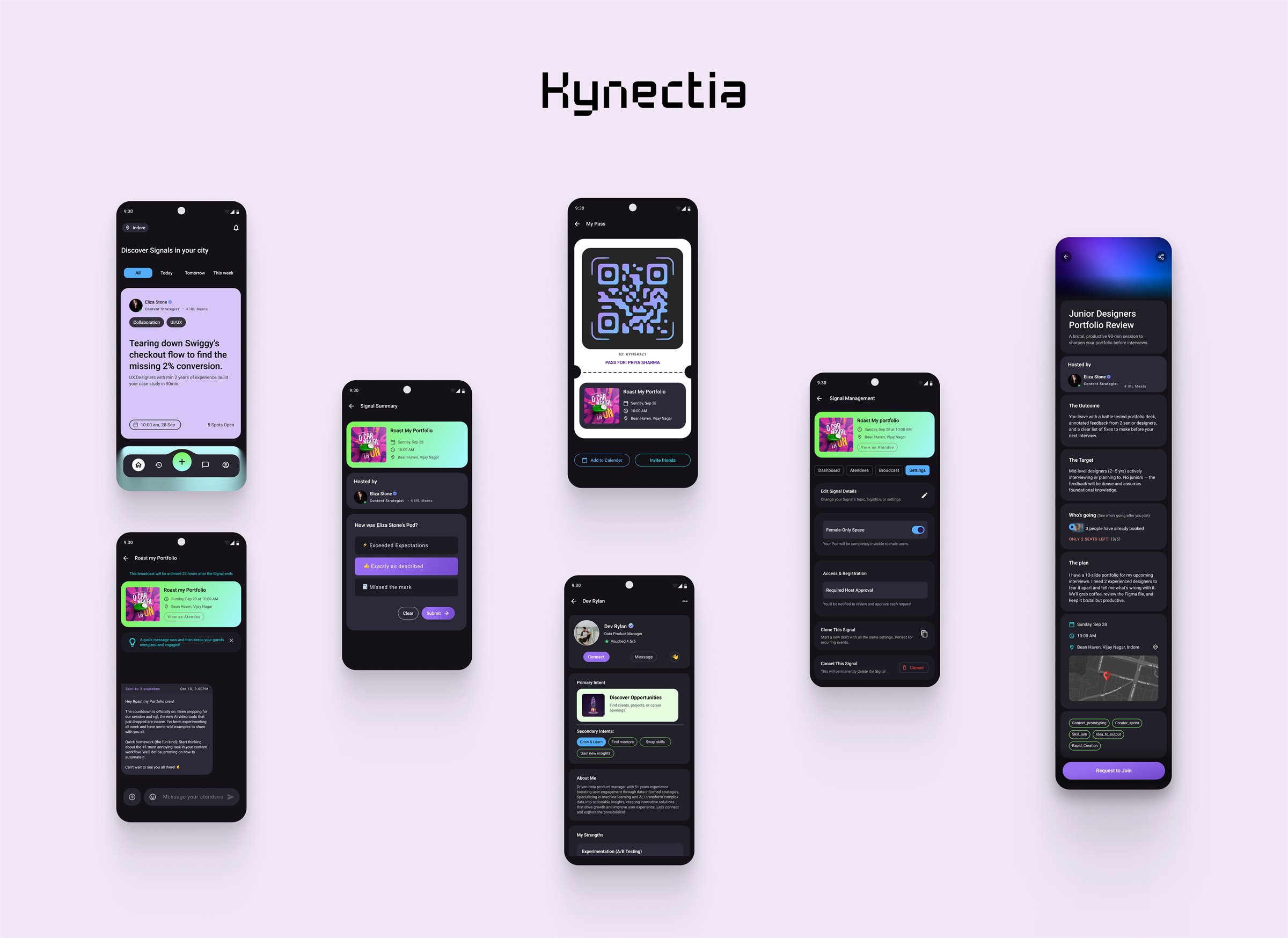
In Kynectia, a user posts a signal, what they need, in plain words.
"Need 20 people to taste my food brand's first batch and give honest feedback."
It goes out across their city. The people it is relevant to are matched to it, see the detail, and apply. The host picks who they meet.
That is the whole inversion. Enblit asked an entire city to assemble before anyone got value. Kynectia lets one person's intent pull the right people toward them. Proximity-first became intent-first, and every dependency that had killed Enblit disappeared with it. Discovery, removed. Café integration, removed. Not trimmed, but deliberately cut, because they gated value behind conditions no single user controlled.
Three decisions behind the rebuild
01Signal creation that feels like talking, not filling a form.
The first version of posting a signal was a blank, multi-field form. In testing, blank fields did what blank fields do: people stalled, unsure what to write. We redesigned creation as a guided conversation. A user describes what they need in their own words, or dumps rough details, and the system asks follow-ups and drafts the structured signal for them, with examples tailored to their context. Every field stays editable afterward.
Intake shifted from "fill this out" to "tell us what you're trying to do," faster to post, and far less intimidating for first-time hosts. It also placed AI in the product where it earns its place: removing the friction of the blank page.
02Designing for women's safety, rather than assuming a toggle solved it.
Enblit's plan was dual profiles, anonymous or public. Interviews kept surfacing a sharper concern: women were not worried about profile visibility, they were worried about meeting strangers in person. A privacy toggle did not touch the real risk.
We dropped dual-mode in favor of the actual problem: women-only signals, visible only to women, and a vouch score, an anonymous, peer-given trust rating every user carries, so people can read someone's credibility before agreeing to meet. Safety stopped being a setting and became part of how the network works.
03Room to decide how people meet.
Signals were first built as scheduled-only, with venue, date, and time locked in at creation. It was rigid, and real plans do not work that way. We added an unscheduled path: a signal can open a broadcast group where host and applicants talk first, then lock a time and place once the fit is clear, as a group meet or one-on-one. Certainty when it is wanted, flexibility when it is not.
Where it stands
Kynectia is in beta and preparing for launch, with a live site and an open waitlist.
The work in one line
An over-built, venue-dependent product was reduced to the one thing the market wanted, rebuilt with its dependencies designed out, and shipped. The vision held. The architecture did not have to.